
Our Experience at the Institut de Français in Nice
What it costs, where to stay, what to eat, and why we're already planning to go back

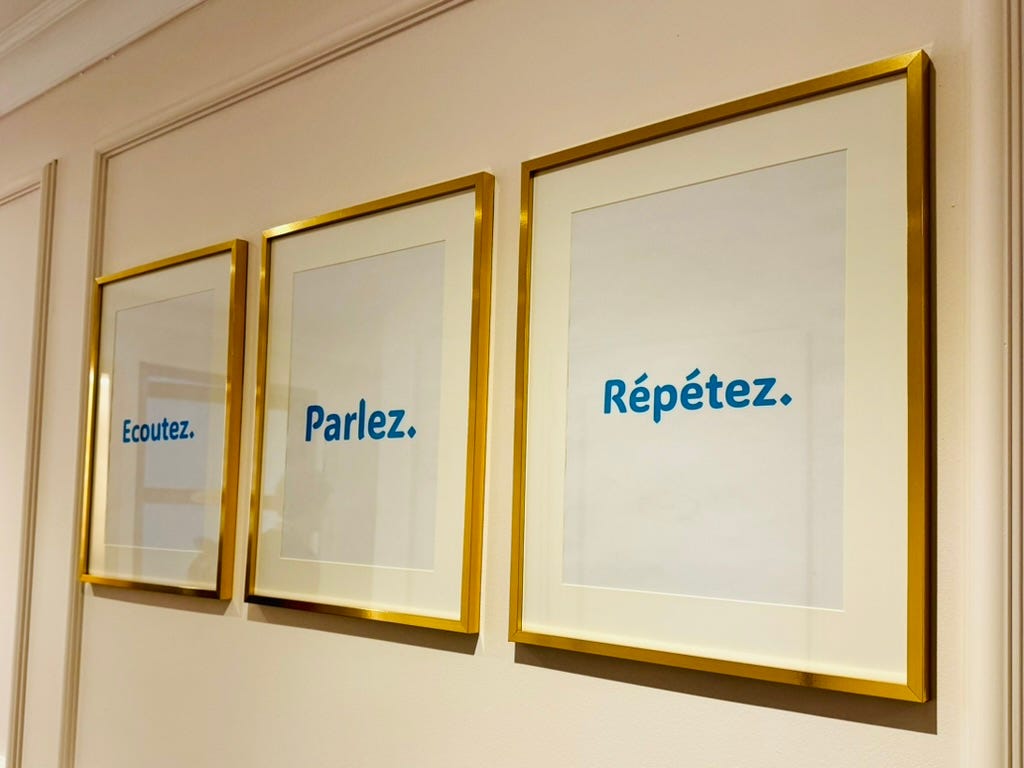
If you’ve read my piece on our two weeks at the Institut de Français — To Be and Not to Be (So Good at French) — you know the broad strokes: six hours of French a day, a bruised ego, and a husband who learned to say “tu es” correctly for the first time in years. What I didn’t get into was the full picture: what it actually costs, where we slept, where we ate, and whether any of it stuck. That’s what this is.
Consider this your practical companion guide.
Let me start with a confession.
I lived in Germany for three years and left without learning German. Not for lack of good intentions — I had plenty of those. But our move turned out to be harder than expected: finding a place to live, medical emergencies, a car accident, unexpected surgeries, two teenage boys finishing high school in a new country after two years of COVID isolation. At some point, survival mode set in and the will to take language classes stealthily evaporated. I decided to do just enough to get by, consoled myself that it was a temporary posting, and kept my eyes on France.
Those three years taught me something important. I was surrounded by German every single day — and I barely improved. Because immersion, on its own, is not a method. It’s just exposure. And exposure without structure mostly teaches you to tune things out.
I arrived in France determined not to repeat that pattern. Language acquisition, I’d decided, was the key to the genuine connection and belonging I was hungering for. Not tourist French. Not “getting by” French. Real French — the kind that lets you argue with a bureaucrat, charm a neighbor, understand what people are saying about you at the market.
The question was how to get there.
Here’s something you probably already know, but I’ll say it again: the best time to start learning French is before you arrive. Take classes, use apps, build a foundation — give yourself something to work with when you land. The second best time is immediately after you arrive. Enroll in something. Make it a priority from day one. That commitment signals to yourself, and to France, that you’re serious about being here.
The third best time is right now. Wherever you are in this process.
And the fourth thing I want to make clear: you will be working on your French forever. That’s not a discouragement — it’s a reframe. French is not a box you check. It’s a practice, like running or cooking. You get better incrementally, and every gain compounds. The goal isn’t fluency as a destination; it’s fluency as a direction.
What I also want to name: you know yourself. Some people can follow a YouTube workout at home and stay consistent. Others need to pay for the gym membership to make it real. Neither is wrong. What matters is that you find the structure that actually works for you and commit to it — because I promise you will never regret a single French lesson you take.
A quick note on levels, because having a concrete goal helps enormously.
French proficiency follows the CEFR scale — the Common European Framework of Reference for Languages, used across Europe. In practical terms for life in France, the thresholds that matter are:
A1 — Absolute beginner. You can introduce yourself, ask basic questions, and understand very slow, simple speech. This is day one.
A2 — Required for your first multi-year carte de séjour pluriannuelle. Basic but functional: you can handle routine interactions, describe your daily life, hold simple conversations. This is the floor, not the goal.
B1 — Required for a carte de résident, the ten-year card. You can manage most everyday situations, follow conversations, and make yourself genuinely understood. This is also where things start to feel like actual fluency.
B2 — Required for French citizenship. Upper intermediate. You can discuss complex topics, engage with the news, and operate independently in professional and social contexts.
One caveat worth knowing: applicants aged 65 and over are exempt from the language test requirements. So if you’re reading this from that particular vantage point — well done on getting here, and also, don’t use it as an excuse (btw, Ralph laughed when he saw this line). Your neighbors will still appreciate it.
Most of us arrive somewhere around A1 or A2, feel reasonably comfortable because we can survive a restaurant meal, and then plateau. The plateau is real, and it’s comfortable, and if you’re on a working visa like me, it will work against you when the renewal paperwork arrives. Because chances are, after going through the process the first time, you’ll do anything to get a multi-year card. At least I know that for me, four years without having to reapply would be a dream!!
How We Chose the Institut de Français
After a year in France, we started to feel that plateau. That’s why we opted to try an immersion – we wanted rapid progress.
The rest of this post is for paid subscribers — and this one's worth it! Below: the full breakdown of what the program costs, where we stayed, where we ate, what we did on weekends, and what happened to our French two months later.
